
Swim Meet 101
BEFORE THE MEET STARTS
1. Bring, your swim cap and goggles as well as swimsuit and team t-shirt. Water and or Gatorade, plenty of towels, chairs and blankets to sit on, coloring books, cards, etc to occupy time, money for meet programs, and bake sale items (you may bring your own food), warm clothes to change in--it can get chilly at night.
2. .Arrive at the pool at least 15 minutes before the scheduled warm-up time begins. This time will be listed in the meet information on the website and also in the team e-mails.
3.Upon arrival, find a place to put your swimmer's blankets, swim bags and/or sleeping bags. The team usually sits in one place together, so look for some familiar faces. There will be lots of down time during the meet – bring something for the swimmers to do.
4.Most of the time we will try to e-mail the swimmer’s entries or heat sheets. This will generally happens in the afternoon before the meet.
You and your swimmer can find heat and lane assignments by looking for the heat sheets posted in the team area.
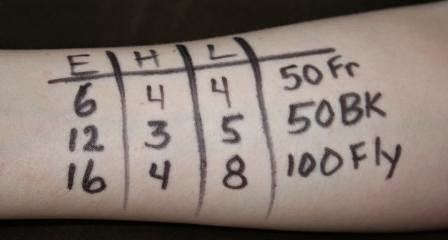
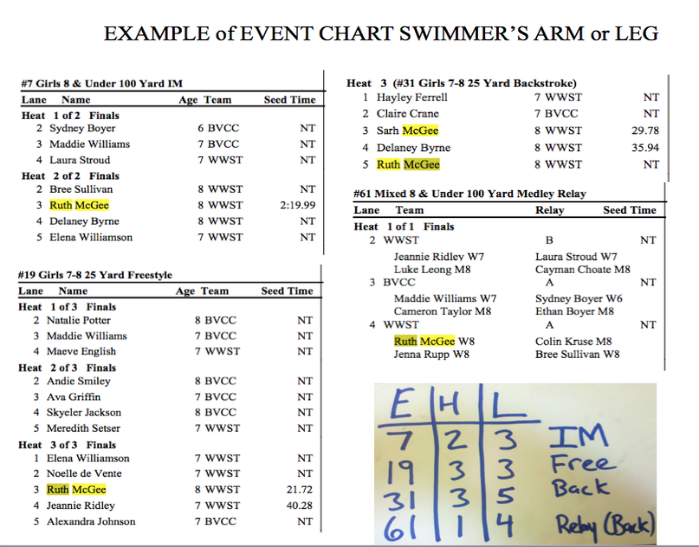
5.Write or have the swimmers write each event-number on his or her hand in ink. This helps him/her remember what events he/she is swimming and what event number to listen or watch for. It will also help adults to help the swimmer find their location. We have also added an attachment to the bottom of the page for more info on marking your swimmer's arm. Please review!
6.Your swimmer now gets his/her cap and goggles and reports to the pool and/or coach for warm-up instructions. It is very important for all swimmers to warm-up with the team. A swimmer's body is just like a car on a cold day-he/she needs to get the engine going and warmed-up before he/she can go all out.
7.After warm-up, your swimmer will go back to the area where his/her team is sitting and wait there until his first event is called. This is a good time to make sure he/she goes to the bathroom if necessary, gets a drink, or just gets settled in.
8.The meet will start after all warm-ups are over. For dual meets the start time is 6pm.
9.Psyche Sheet or Heat Sheets. It lists all swimmers in each event in order of "seed time". When the team entry is sent in, each swimmer and his/her previous best time (up to the date that the entry was submitted) in that event is listed. If the swimmer is swimming an event for the first time, he/she will be entered as a "no-time" or "NT". A "no-time" swimmer will most likely swim in one of the first heats of the event. A Heat sheet may be available close to the start of the meet that lists the actual heat and lane a swimmer will be competing in.
10.Parents
who have volunteered their time will report to their respect areas.
MEET STARTS
1.It is important for any swimmer to know what event numbers he/she is swimming (again, why they should have the numbers on their hand). He/she may swim right away after warm-up or they may have to wait awhile. BRING SOMETHING TO DO DURING THE MEET.
2.Most meets are computerized. There are generally two ways a swimmer gets to his/her lane:
A swimmer usually reports directly to his/her lane for competition a number of heats before he/she actually swims. Check with your swimmer's coach for specific instructions.
In our summer meets, a swimmer's event number will be called, usually over the loudspeaker, and he/she will be asked to report to the "clerk of course" or “bullpen”. Swimmers should report with his/her cap and goggle. Generally, girl’s events are odd-numbered and boy’s events are even-numbered. Example: "Event #26, 10-Under Boys, 50 freestyle, report to Clerk of Course." The "Clerk of Course" area is usually where all swimmers are checked in. The clerk will usually line up all the swimmers in correct order. You can expect at least 4-8 heats of each event.
3.There are various jobs that need to be filled so that we can run a successful meet for the swimmers. There are timers who will write down the times for the swimmers. We will have a timer from each team at each lane to make sure that we have correct times. There are officials that judge the swims legal. There are clerk of course to make sure the swimmers are in the right lanes. There is an announcer that will keep the meet running.
4.The swimmer swims his or her race.
5.There are 5 different events the swimmers can be entered into: Freestyle, Backstroke, Butterfly, Breaststroke and Individual Medley (FLY, BACK, BREAST, FREE) and 2 different types of relays: Medley Relay (BACK, BREAST, FLY, FREE) and Freestyle Relays. Most swimmer’s will compete in a stroke that the coach thinks the will be successful for the swimmer. It is very important to the coaches to build confidences of their swimmers.
6.Keep in mind the time for various events for instance: 200 Freestyle might take a few minutes where as a 50 Freestyle might take 30 seconds.
7. Each swim is judged by an official to keep everything fair. Some parents might say that we should be easy on the swimmers – it is only a recreation team. To keep it fair – if it is a butterfly event and one swimmer swims the event freestyle that freestyle swimmer will be disqualified (DQ) and no score will take place. Sometimes that does not seem fair. The question to ask is when should a swimmer be disqualified – at 6 when they are learning the stroke or at 12 when they have learned the stroke with bad habits. It is always better to disqualify the swimmer from the start so they can learn good habits.
8.After each swim:
He/she is to ask the timers (people behind the blocks at each lane) his/her time.
Depending on the coach’s instructions, the swimmer may be asked to do some recovery swimming if a "warm down" pool or lanes are available.
The swimmer should then go immediately to his/her coach. The coach will discuss the swim with each swimmer. Some coaches may wish to talk with the swimmer before his/her recovery swim.
9.Generally, the coach follows these guidelines when discussing swims:
Positive comments or praise
Suggestions for improvement
Positive comments or praise
10.Things you, as a parent, can do after each swim:
Tell your swimmer how great he or she did!
The coaching staff will be sure to discuss stroke technique with their swimmer. You need to tell your swimmer how proud you are and what a great job they did.
Tell your swimmer to back to the team area and relax.
This is another good time to check out the bathrooms, get a drink or something light to eat.
It is very important that swimmers stay hydrated during the meet.
11.The swimmer now waits until his next event is called and starts the procedure again.
12.Please make sure that you are respectful of the facility and clean up after yourself.
13.Results are usually posted on the website. Awards are often gathered for a team and given to the coach at the end of the meet.

